DeepSeek
Harness.
The interesting part is not that it can act like a coding agent. It is that it shows you the machinery—and invites you to rearrange it.
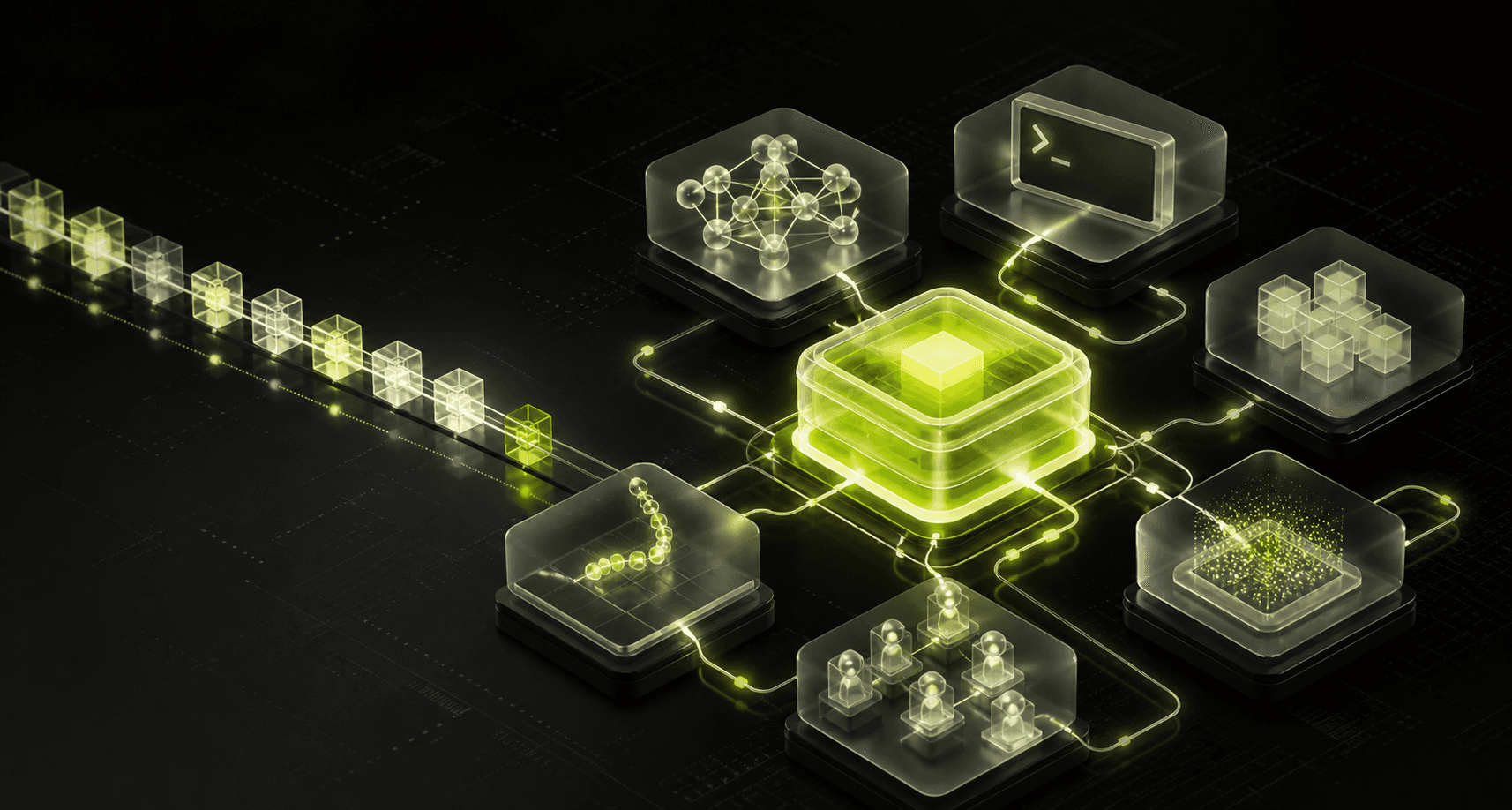
Codex and Claude Code have made a strong case for a useful default: open a terminal, give the agent a real repository, then steer it through work. DeepSeek Harness starts one layer lower. It asks what happens when the agent’s runtime is as much a product surface as the model.
DeepSeek has released the project as an open-source developer preview, built on the Cordis plugin system. Treat the preview label seriously—its APIs can change—but the design is already unusually legible: capabilities are components; work is an event stream; the runtime has explicit modes.
The agent is a composition, not a box.
DeepSeek Harness puts models, tools, skills, session storage, sandboxes, scheduling and UI behind Cordis plugins. That is a more radical promise than extensibility: the default agent is itself an arrangement you can replace. For a Codex or Claude Code user, the interesting question becomes which parts of your daily loop should stay opinionated—and which deserve to be yours.
The transcript is not the source of truth.
The visible chat is only a projection. DSH keeps an append-only, typed event log as the source of truth, then derives the exact message history from it. Model-visible inputs have to be logged; a request header captures the system prompt, tool schemas and call configuration. Tool calls, results, steering messages, compaction and subagent scheduling all have distinct records and sequence numbers. That is observability by construction, not a trace bolted on after the agent has already acted.
Modes are a serious design surface.
Standard mode is the broad coding-agent setup. Code mode lets the model orchestrate multiple tool calls in TypeScript. Minimal mode reduces the environment to a persistent shell and a file editor for cleaner evaluation. Creator mode exposes runtime inspection and in-memory plugin experiments. These are not personality presets; they make the harness itself part of the experiment.
THE OBSERVABILITY BET
When an agent surprises you, the question is not just “what did it do?” It is “what exactly did it see, and which event put it there?”
Most coding-agent debugging begins with a transcript and a hunch. DSH’s event model gives you a stronger reconstruction: identify the precise request boundary, inspect the system prompt and tool schemas active at that moment, then trace the tool result or context injection that entered the model surface. The model history is re-derived from the log rather than copied into a separate, mutable transcript.
That distinction makes fork and replay operational tools. You can branch from a known event boundary, change one variable—provider, plugin, policy, context rule—then compare the resulting run without pretending the original was deterministic. For a team, this is the beginning of a real incident review for agent work: evidence first, interpretation second.
Context provenance. Inspect which user message, tool result, compaction, or steering event made it into a model request.
Request reconstruction. Recover the call configuration, rendered system prompt, and assembled tool surface at the request boundary.
Live hooks without a forked loop. Plugins can observe durable session/event records or intercept live agent and tool seams.
Telemetry as an optional capability. The same event stream can be projected to an external telemetry backend, with redaction at the reporting seam.
THE TAKE FOR CODEX + CC USERS
Don’t switch tools just to chase a longer feature list. Try it if you want to make the harness a first-class part of your practice.
DeepSeek Harness is compelling when the defaults are no longer the work: when you need a deliberately small benchmark environment, a forensic replay after a bad tool decision, a custom approval boundary, or a trace you can use to improve the next run. In that sense, it is less a replacement for Codex or Claude Code than a sharp argument for exposing their seams—and making agent behaviour observable enough to engineer.
READ THE PRIMARY SOURCES
DEEPSEEK HARNESS DEVELOPER PREVIEW SOURCE CODE + DEVELOPER PREVIEW NOTESLATEST WEEKLY
Keep the signal
close.
One considered developer dispatch each week. No flood, just the things worth carrying forward.
JOIN THE WAITLIST